Posts

Wired for Training

Image
Bob and I continued to add hard black locust posts to the vineyard.  I ordered the 12 gauge steel wire on the web from Ace Hardware.  We wired the 12 gauge four feet off the ground and the 16 gauge two feet up.  I tied the vines that reach the four foot high wire to the wire using gardening twine.  As of today, fewer than 10 of the 100 vines reach that height.      The first casualty appears to be vine on the fourth row from the bottom.  When I came up this weekend, all the leaves were brown and wilted.  I cut off the leaves in hopes that something might be salvaged.  We are under drought-like conditions in the Hudson Valley this summer, with very little rain in June and almost none in July.  The plants are also being attacked by the Japanese beetle and fat green leaf-like caterpillars.  I am trying to avoid pesticides this year, but I may have to cave in if the damage gets much wor...
Vines On The Hill

Image
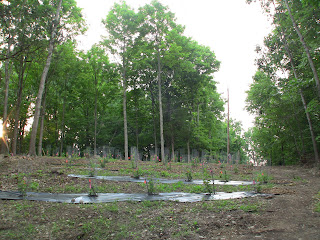
We laid black plastic, cutting holes for the vines. Then we added wood chips over the plastic. It was grueling, but Bob McCrindle and I put in the first posts.  The end posts are nine feet long and buried three feet down.  The center posts are eight feet long and buried two feet down.  We tied a 16 gauge wire across the posts.  The support wires will be 12 gauge galvanized steel. The vines are growing fast.  This one is almost five feet tall.

100/100 Riesling Plants Emerge

Image
Three weeks after planting and all the Riesling vines are coming up.  The tallest is already more than a foot high.  Dog for scale. Another amazing sunset over the Hudson.

Vineyard or the Next Modern Art Installation at Dia Beacon

Image
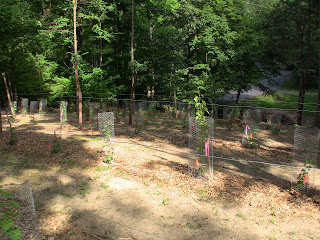
We worked through the weekend to plant 100 vines.  It never would have been possible without Bob McCrindle's tractor.  The hill was filled with rocks of varying size and shape, and roots covering every cubic inch of earth.  Now that the vines are in the ground, they must be protected.  We shaped chicken wire fences around each of them.  Looking up the hill.     Looking down towards Floyd Ackert Road. We then added a little mulch to cover the fragile union between the rootstock and the vine.  When the vines start to grow, we'll remove the chicken wire fences and train the vines on a wire trellis that will be anchored by six-foot wooden posts.      Alicia working in front of the Shier.

Class of 2009

Image
I bottled the first 25 bottles of the 2009 Riesling over the weekend.  This is my first attempt to make the wine as the German winemakers described it to me at the Riesling & Co. Wine Tasting at the Tribeca Rooftop.  I limited my fermentation and post fermentation adjustments to sulphites and chilling.  No fining, no filtering, and no preservatives.  The wine exhibits a more complex, flowery flavor.  It is a tiny bit sweeter than last year, but I would still classify it as semi-dry or dry.  The new bottle color combination is amber and gold.      

Vineyard Planning

Image
The vines are set to arrive on May 5. They must be soaked in water for 24 hours and immediately thereafter planted in one foot of loose soil.  Bob McCrindle has been hard at work clearing the yard.  We will plant by digging a 1 foot deep trench for each row using the tractor.  I've put together a rough layout of how the vines will be arranged on the hillside.  The 100 Riesling grape vines will be composed of 4 clones.    The bottles arrived for the 2009 Riesling. I decided not to risk the whole lot on my "making it the German way" experiment. I added KC Super Kleer to two of the three carboys (one oaked and one unoaked). I will filter these carboys down to 6 microns. The third carboy (also oaked), I placed in the refrigerator. I'm planning to bottle the third carboy German-style, sans fining, filtering, and preservatives.  I put together a cherrywood wine rack.  Each of these racks will hold 126 bottles.

Creating The Vineyard

Image
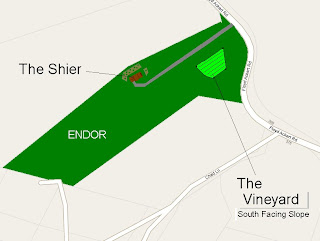
This map of the Shier shows the vineyard that I am working on.  Our neighbor, Bob McCrindle, is clearing a space with his chainsaw and tractor.  In early May, I will plant 100 Riesling plants grafted to root stock.