Posts

Why Not Drink From The Bottom Of The Barrel?

Image
Budweiser runs ads on the 4 and 5 trains in New York touting its beechwood aging.  Beechwood chips are placed in the beer tanks for three weeks, which the ad states is "expensive."  It is, however, cheaper than aging Budweiser in old Kentucky beechwood barrels.  Wood chip aging is also much faster than waiting for a barrel to impart the same flavor.  I use toasted french oak chips in the Riesling, aging for two weeks.  The chips cost about $15 for a 10 pound bag (which are advertised for BBQing).  I tried toasting a little natural oak from trees cut down to make room for the grape vines, but my effort was not worth the result.  There are a number of oak species, some good for winemaking and others good for making poison.      Why shouldn't you drink from the bottom of the barrel? The yeast and spent oak chips make for a nasty brew.

2010 Riesling Fermentation Curve

Image
The basement at the Shier provides a perfect environment.  With steady cool temperatures, the juice undegoes primary fermentation over three weeks.  The chopiness in the brix curve (the green) is most likely small measurement error as opposed to variation.  The temperature variations may be a result of overshoot and undershoot on the temperature controller.  A flat temperature line and a long slow sloping brix curve are best for Riesling.  I racked the wine to carboys on Sunday.  The brix is 1.77 and the taste is intense.  It's been a good year for Riesling.

Back to the Finger Lakes

We made a trip out to Keuka Lake on Saturday.  I picked up 16 gallons of Riesling juice and 5 gallons of Concord.  The Riesling looks perfect this year, with a hint of noble rot.  Brix is 23.5, so no need to add sugar.  The Concord was fairly inexpensive at only $4.75 a gallon.  I figured I would take a crack at making a better wine than Manischewitz.  The Concord brix was only 16.6, which means it needs a lot of added sugar.  Oh well, Manischewitz doesn't exactly set the bar very high.     

Vines in Fall

Image

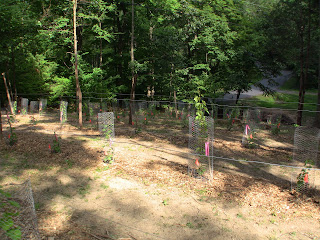
First Year Vines Going Strong

Image
Some northern rays. A few wires still need to be added.

Wired for Training

Image
Bob and I continued to add hard black locust posts to the vineyard.  I ordered the 12 gauge steel wire on the web from Ace Hardware.  We wired the 12 gauge four feet off the ground and the 16 gauge two feet up.  I tied the vines that reach the four foot high wire to the wire using gardening twine.  As of today, fewer than 10 of the 100 vines reach that height.      The first casualty appears to be vine on the fourth row from the bottom.  When I came up this weekend, all the leaves were brown and wilted.  I cut off the leaves in hopes that something might be salvaged.  We are under drought-like conditions in the Hudson Valley this summer, with very little rain in June and almost none in July.  The plants are also being attacked by the Japanese beetle and fat green leaf-like caterpillars.  I am trying to avoid pesticides this year, but I may have to cave in if the damage gets much wor...

Vines On The Hill

Image
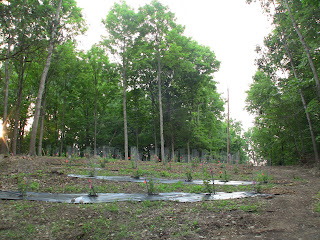
We laid black plastic, cutting holes for the vines. Then we added wood chips over the plastic. It was grueling, but Bob McCrindle and I put in the first posts.  The end posts are nine feet long and buried three feet down.  The center posts are eight feet long and buried two feet down.  We tied a 16 gauge wire across the posts.  The support wires will be 12 gauge galvanized steel. The vines are growing fast.  This one is almost five feet tall.