Posts

Creating The Vineyard

Image
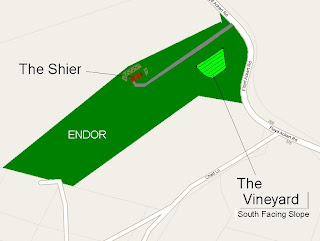
This map of the Shier shows the vineyard that I am working on.  Our neighbor, Bob McCrindle, is clearing a space with his chainsaw and tractor.  In early May, I will plant 100 Riesling plants grafted to root stock.

Shaping Up

Image
A dramatic improvement in the 2009 Riesling vs. the 2008 in terms of color, clarity, and as it turns out from today's testing, acid levels.  The wine is so clear that I am planning to forego the fining process.  Depending on how well cold stabilization goes I should be able to forego adding any potassium sorbate.  And with so little oxidation, I also should be able to avoid adding polyclar.  In other words, I'm making the 2009 with much the same purity as the Riesling from the Moselle Valley.     The SG measured 1 degree Brix.  Back in October, I started at a Brix of 23, which means a potential alcohol of 13.2%. I brought out the acid test kit and tested a sample.  The pH was 3.25 and the total acidity was 0.95 Tartaric.  Acceptable.  Cold stabilization should help. Alicia and I also gave the wine the most important test.  It is remarkably good.  I am very surpr...

The Farm Winery

As spring approaches and the 2008 Riesling drys and clears, I am focusing the winery on the important task of becoming licensed to sell wine. New York has several types of winery licenses. A typical micro winery license requires a yearly license fee in excess of $1,000 and a $10,000 bond. A special farm winery license is available for $175 per year and a $1,000 bond. The key requirements of a New York farm winery license are: 1) Only use New York grown grapes 2) Need to have a farm (no minimum acreage requirement) 3) No more than 150,000 gallons of wine annually Requirements 1 and 3 have never been a problem for the Shier Winery. Requirement 2 is more complicated. I sought further guidance from the New York Liquor Authority on the minimum requirements for a farm. I never received an answer, but the application instructions are very clear that there are no minimum acreage requirements. I decided to clear a small portion of land and to plant Riesling vines this May. I have reason ...

Wine Winter

Image
Blackberry pictures are rough, especially when using the flash. Making such a short trip up to the Shier, I forgot the good camera. The wine continues to dry and is now starting to clear. It has a pleasant bouquet, but I will wait until next time to taste. A not-so-bad picture taken on my Blackberry. View of Newburgh from Beacon.

Racking in the New Year

I racked the wine off the sediment on Sunday morning. Many of the oak chips had settled to the bottom of the carboys. There were small crystals on the chips, which looked somewhat like the precipitate of tartaric acid. It was surprising because the carboys were not subjected to freezing temperatures . The temperature on the basement floor was about 51-52F, after slowly dropping from around 57F at the time the wine was placed in the carboys in November. It seems more likely that it could be the precipitate of the potassium bicarbonate that was added to the juice at the vineyard. I will hold off on testing the acidity levels until the next racking about a month from now.

Oaking on New Year's Eve

Image
A little over a month into the secondary fermentation phase and the wine continues to dry down. The great reaction from last year's oaked Riesling bottles has encouraged me to add oak to two of the three carboys this year. I must say that I cannot even taste the oak from the chips, but I can recognize what seems to be an increased fullness in the wine. The faint bitterness from the oak perhaps adds an element that complements the sweetness and acidity of the wine and fills out the palate.

Going Four Weeks in the Winepod?

I checked on the Riesling this past Sunday, three weeks after start of fermentation. The Winepod read a Brix of 8 and my hydrometer read close to 9. Last year, the Riesling was close to zero after three weeks. The difference could be a tighter control on temperature, since I set the targets further apart this time to prevent overshoot by the heater and cooler. The temperature has been a near steady 62 degrees from the start, whereas it drifted briefly up to 65 last year. The difference could be a slight increase in available sugar, but this is unlikely, because the starting Brix was within a degree or two of last years' starting point. The difference could be a higher level of SO2. I did not measure the amount of SO2 added by the vineyard, but I have no reason to suspect a spike this year. The difference could be the potassium bicarbonate added to reduce a higher starting acid in the grapes or the difference could be the higher acid itself. Whatever the reason, I decid...